
Key Takeaways
- Restore lets you restore a Windows 365 Cloud PC to an earlier working state.
- A backup is required before you can restore a Cloud PC.
- Files, apps, and changes made after the selected restore point will be lost.
- Admins can restore one Cloud PC or multiple Cloud PCs at the same time.
- This feature helps recover Cloud PCs quickly from update issues, accidental changes, or other problems.
Restoring a Windows 365 Cloud PC using Point-in-Time Restore returns the Cloud PC to the exact state it was in at the selected restore point. While this feature is useful for recovering from software issues, failed updates, or accidental changes, it’s important to understand that any local changes made after the selected restore point will be permanently lost. This includes newly created files, installed applications, configuration changes, downloads, and other local data. However, files stored in cloud services such as OneDrive remain safe and are not affected by the restore.
Table of Content
Table of Contents
How to Backup and Restore Windows 365 Cloud PC
Another important consideration is that some applications and services use passwords, certificates, security tokens, or encryption keys that change over time. If these credentials were updated after the selected restore point, those applications or services may stop working correctly until they are reauthenticated or reconfigured. Before performing a restore, administrators should carefully choose the appropriate restore point and understand the impact on users and business applications.
- Windows 365 Cloud PC Deployment Provisioning Process Step by Step Guide
- Windows 365 Cloud PC Azure AD Joined Provisioning Process
- Business Edition Windows 365 Cloud PC End User Provisioning Experience Walkthrough
Risks and Results of Restoring Windows 365 Cloud PC | Back & Restore Risks
It’s important to understand the risks involved with the point-in-time backup and restoration of the Cloud PC option. Cloud PCs have the same risks as all Windows PCs when performing a full disk restore. These risks and results include:
- All changes made to the Cloud PC between the saved restore point and when the restore is started will be lost.
- This lost information includes all data, documents, installed applications, configurations, downloads, and other changes. External data stored in cloud services, like OneDrive, won’t be lost.
- Various applications, agents and tools also use rolling passwords, secrets, certificates, and keys. If any of these credentials are updated between the current time and the restore point, the associated service or application will be impacted.
Configure Backup or Point-in-time Restore Settings for Cloud PC
Before using the point-in-time restore feature, you must configure the appropriate settings in a new or existing user setting.

- Sign in to the Microsoft Intune admin center.
- Navigate to Devices > Manage Windows 365 Cloud PCs > Create > User Settings.
Here you can see we have already created a local admin policy, you can modify that existing one or create a new setting. Here I am creating new user settings.
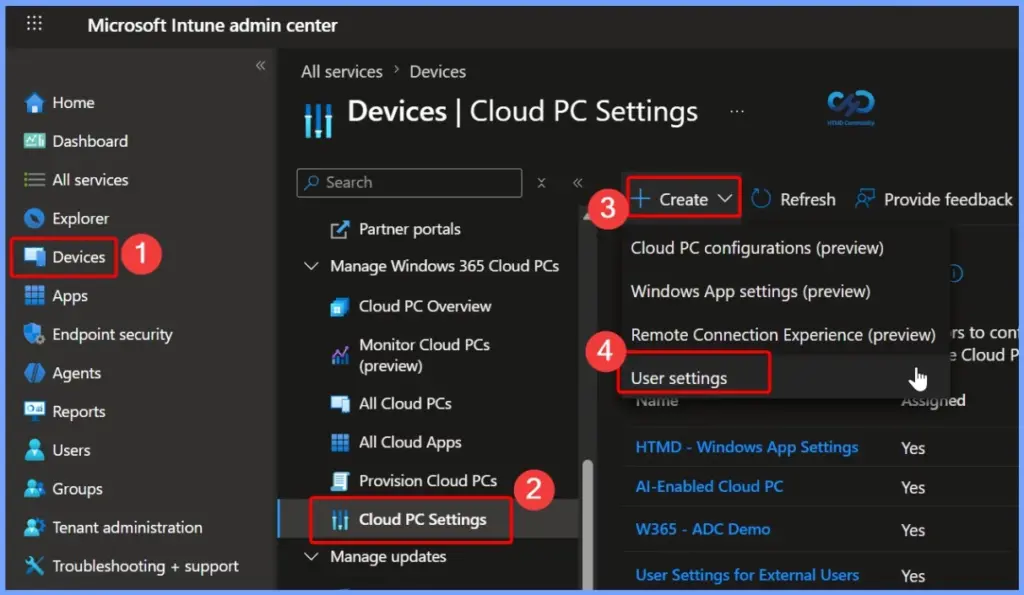
Configure User Settings for Windows 365 Point-in-Time Restore
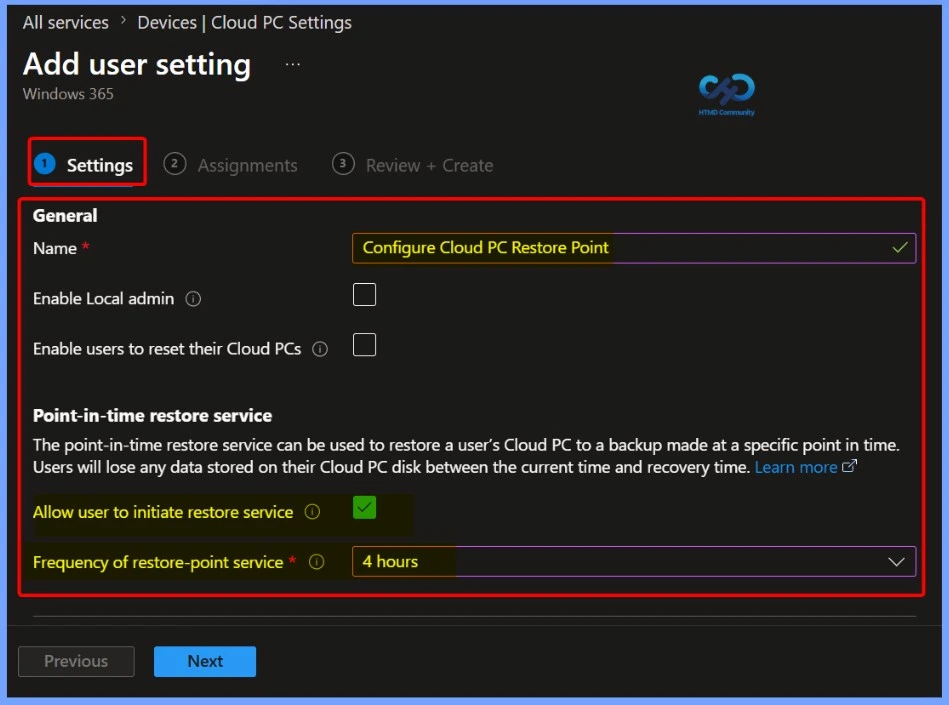
On the Add user settings page, configure the settings that control Point-in-Time Restore and local administrator access for Windows 365 Cloud PCs. Start by entering a policy name (for example, Configure Cloud PC Restore Point). You can choose whether users should have local administrator rights on their Cloud PCs and whether they are allowed to restore their own Cloud PCs using the Point-in-Time Restore feature.
Enter the Name of the User Settings Policy (For example – Configure Cloud PC Restore Point)
- Enable Local Admin – If you want the users for this setting to have local admin rights, select Enable Local admin.
- Allow user to initiate restore service – If you want end users to have permissions to restore their own Cloud PCs, select Allow user to initiate restore service.
- Frequency of restore-point service – choose an interval for how often restore points will be created. There’s a limit of 10 restore points. So a shorter frequency results in a shorter overall history of restore points.
- You can choose to save short-term restore points every 4, 6, 12, 16, or 24 hours.
- Click on the Next button to continue backup options for CLoud PC.
In addition to these configurable short-term restore points, four long-term restore points aren’t configurable. These long-term restore points are saved every seven days. As time passes and a new restore point is added, the oldest restore point is removed.
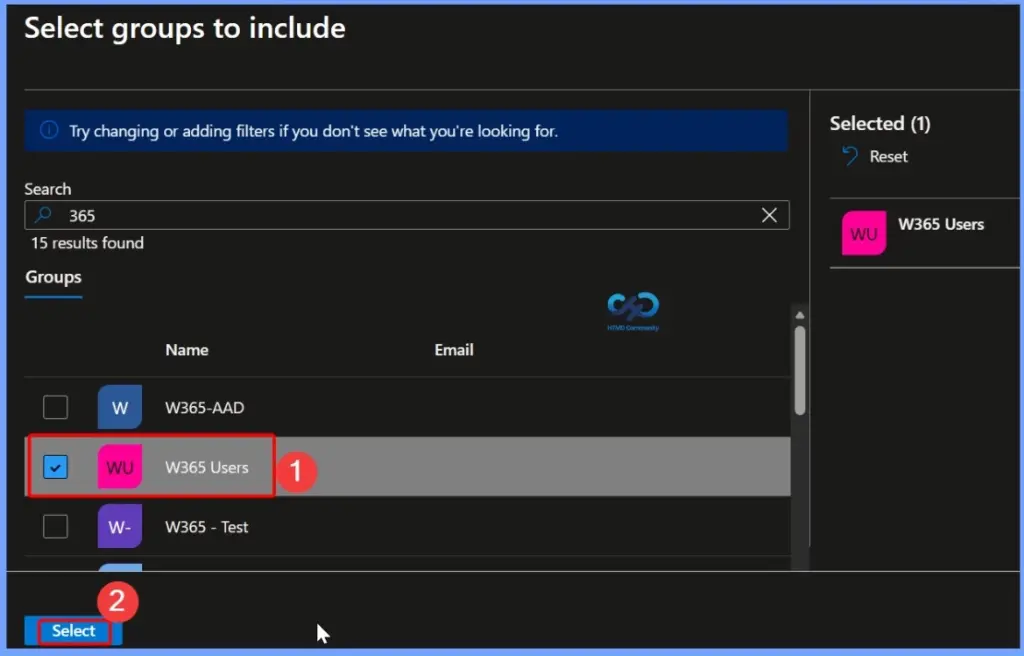
Assign User Settings Policy
On the Assignments page, select the Microsoft Entra user or group that should receive the Windows 365 user settings policy. In this example, the W365 Users group is assigned, which contains the users who will use Windows 365 Cloud PCs. Any users included in the assigned group will receive the configured settings, including the Point-in-Time Restore feature if it is enabled. After selecting the required group, click Next to continue creating the policy.
Review the specified settings on the Review + create page and click on Create. Now, your Cloud PC backup is scheduled for every 4 hours? What do you think? about the above configuration?
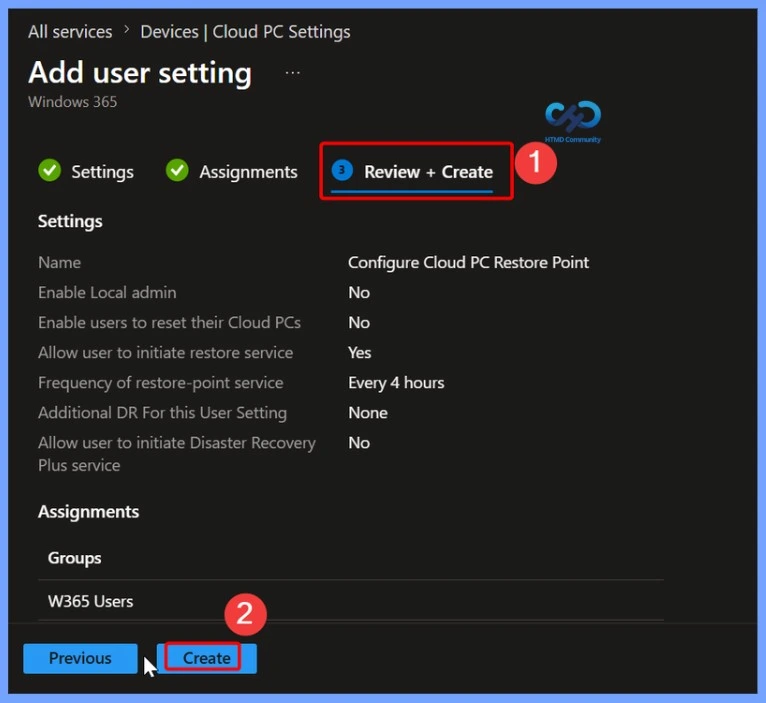
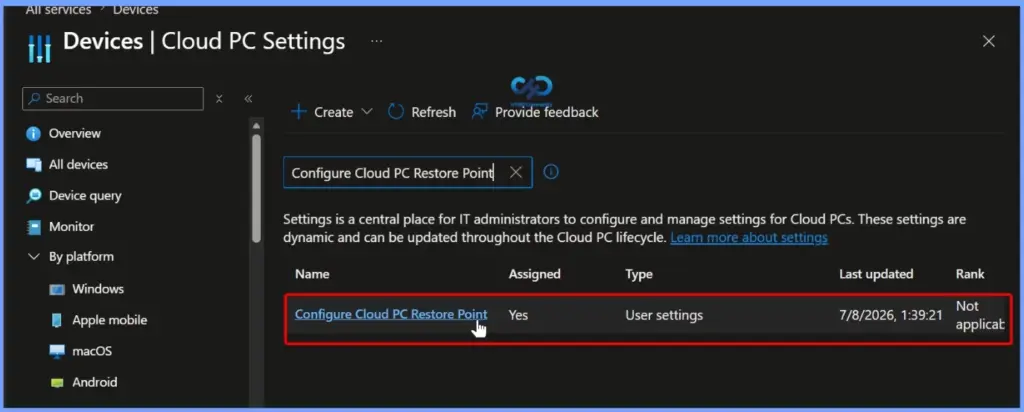
A notification will appear automatically in the top right-hand corner with a message. Here you can see that Successfully added new user setting. The newly created user setting is shown in the User Settings tab.
How to Restore Windows 365 Cloud PC
Let’s follow the steps below to restore a single Cloud PC to a previous state – The first step is to log in to the Microsoft Intune admin center https://intune.microsoft.com/.
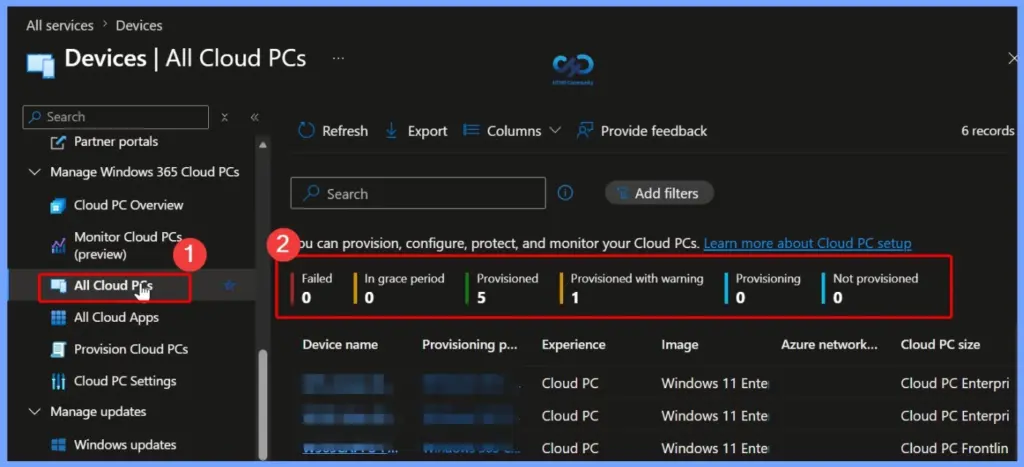
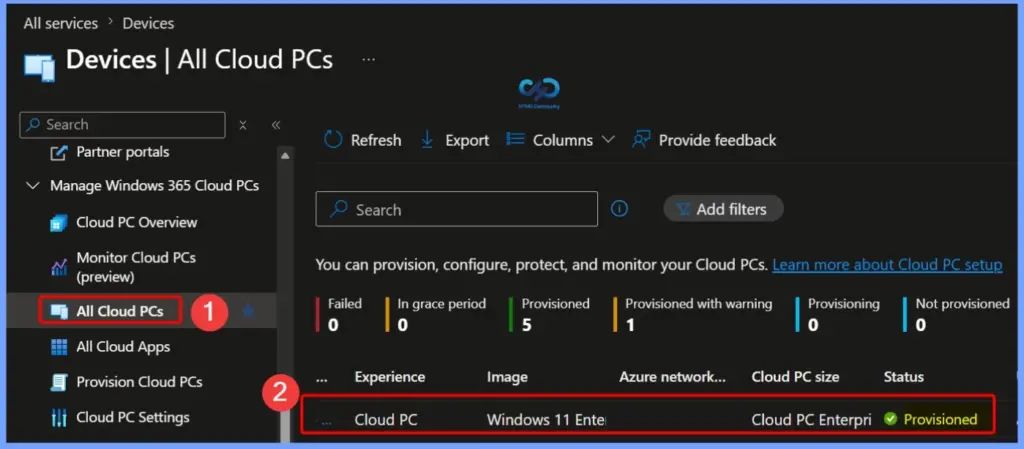
- Navigate to Devices > All Cloud PCs tab to view all the available cloud PCs.
| Failed | In grace period | Provisioned | Provisioned with warning | Provisioning | Not provisioned |
|---|---|---|---|---|---|
| 0 | 0 | 5 | 0 | 0 | 0 |
Restore a Windows 365 Cloud PC to a Previous Restore Point
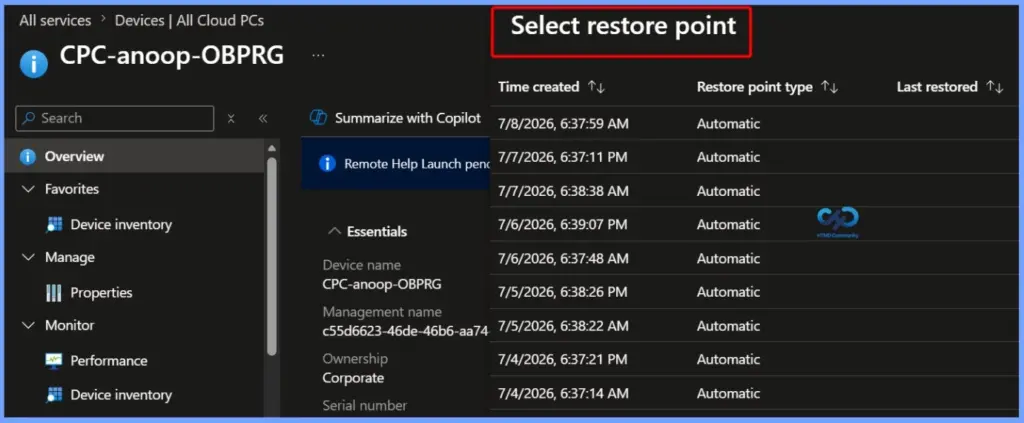
Select Restore, then choose the restore point you want to use under Select restore point, and click Select. A confirmation message will appear, informing you that any local files, apps, settings, and other changes made after the selected restore point will be permanently removed. Review the selected restore point carefully, then click Yes to start the restore process. The Cloud PC will be restored to the exact state it was in at the selected point in time.
Monitor the Cloud PC Restore Process
After selecting the restore point, click Restore to confirm the action and begin the restoration process. On the All Cloud PCs page in the Microsoft Intune admin center, the Cloud PC status changes to Restoring until the process is complete. During this time, the Cloud PC is unavailable for use.
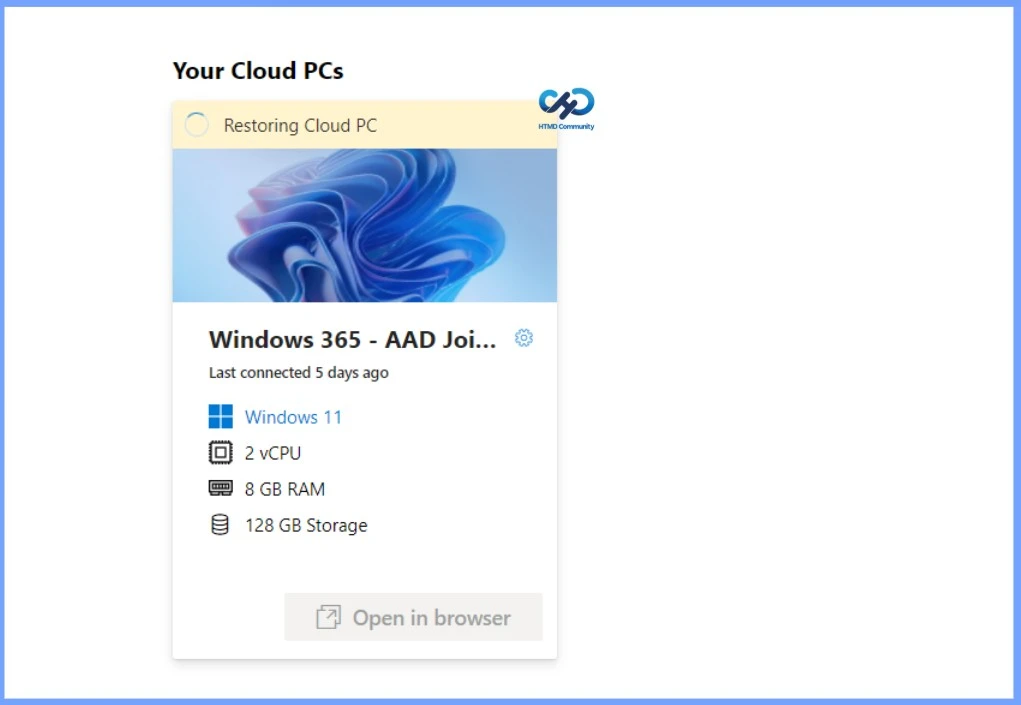
From the Windows 365 web portal, end users will also see the Cloud PC status as Restoring Cloud PC. The Open in browser option is disabled (grayed out) until the restore operation finishes. Once the process is complete, the Cloud PC returns to its selected restore point and users can access it again.
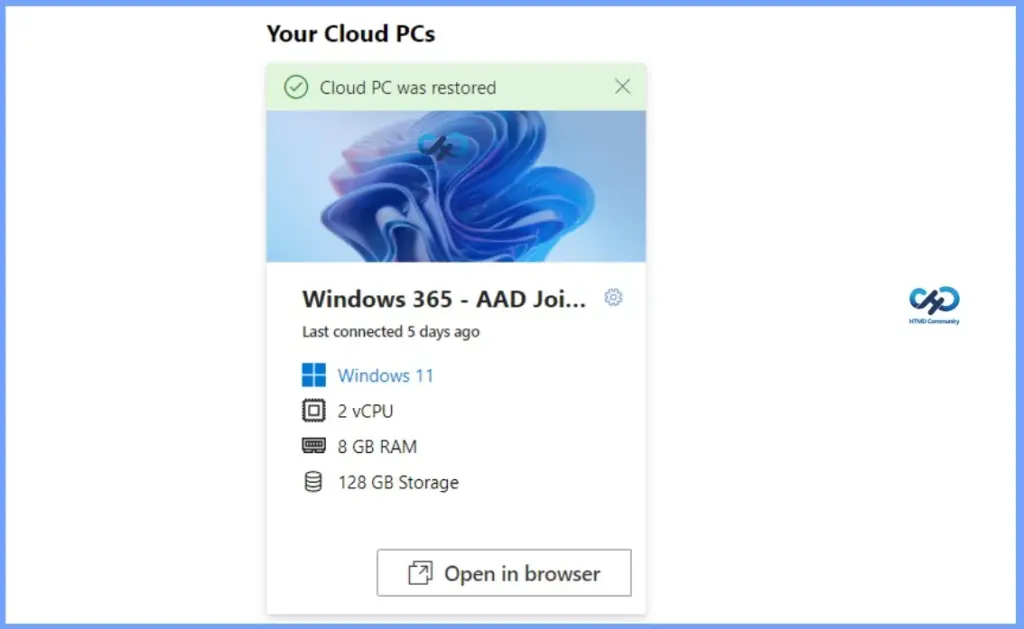
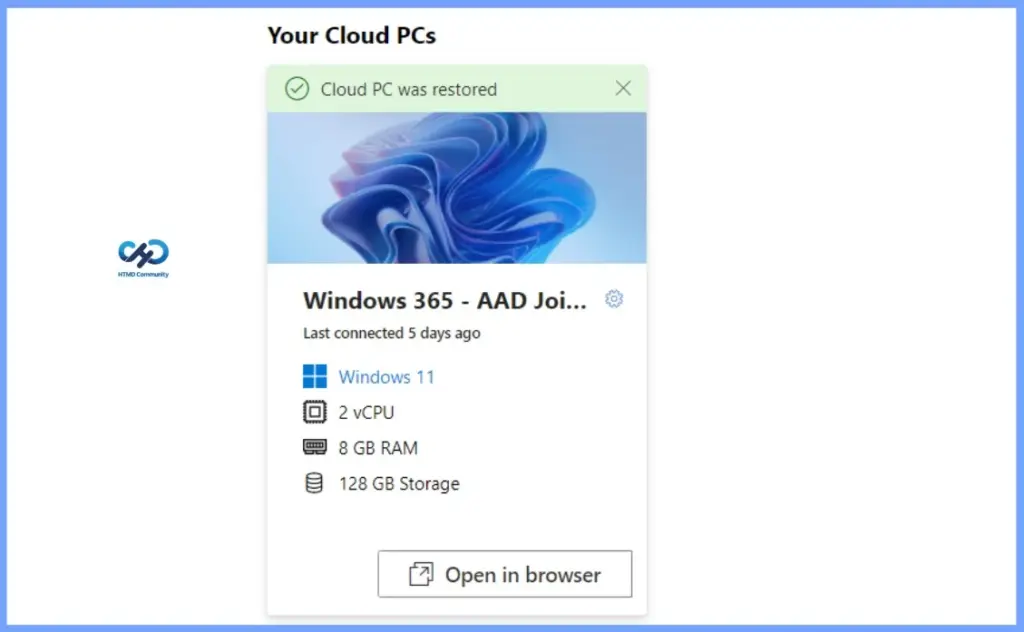
Here you can see that your Cloud PC was restored successfully. The end user once again has the option to “Open in browser.” Let’s select Open in browser to see the Windows 365 Cloud PC experience.
Once the Cloud PC restore process is complete, in the MEM portal, on the All Cloud PCs page, the device’s status will change to Provisioned.
Restore Multiple Cloud PCs in Bulk
Let’s follow the steps to bulk restore multiple Cloud PCs from MEM Portal.
- Sign in to the Microsoft Intune admin center.
- Navigate to Devices > All devices > Bulk Device Actions.
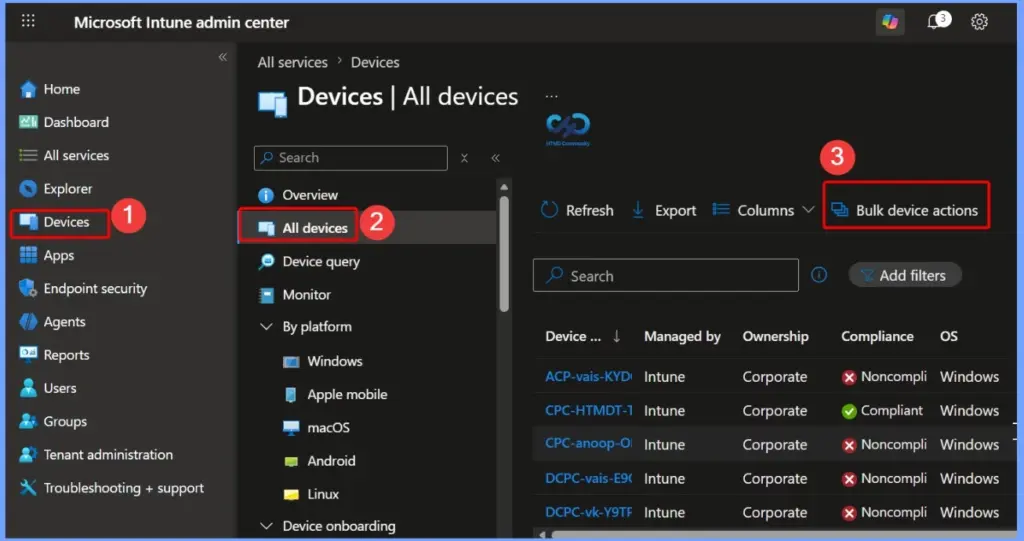
Configure Bulk Restore Options for Windows 365 Cloud PCs
When performing a bulk restore, configure the restore settings to determine which restore point will be used for the selected Cloud PCs. First, set OS to Windows and choose Restore as the Device action. Then, specify the date and time you want to restore the Cloud PCs to. Windows 365 uses this information to select the appropriate restore point based on your chosen option.
- Select Restore Point Time Range
- Choose one of the following options to determine which restore point is used:
- Before specified date and time – Restores the Cloud PCs to the closest available restore point before the date and time you selected.
- After specified date and time – Restores the Cloud PCs to the closest available restore point after the date and time you selected.
- Whichever is closest (before or after specified date and time) – Restores the Cloud PCs to the restore point that is closest to the selected date and time, whether it is before or after.
- After configuring the required options, click Next to continue with the bulk restore process.
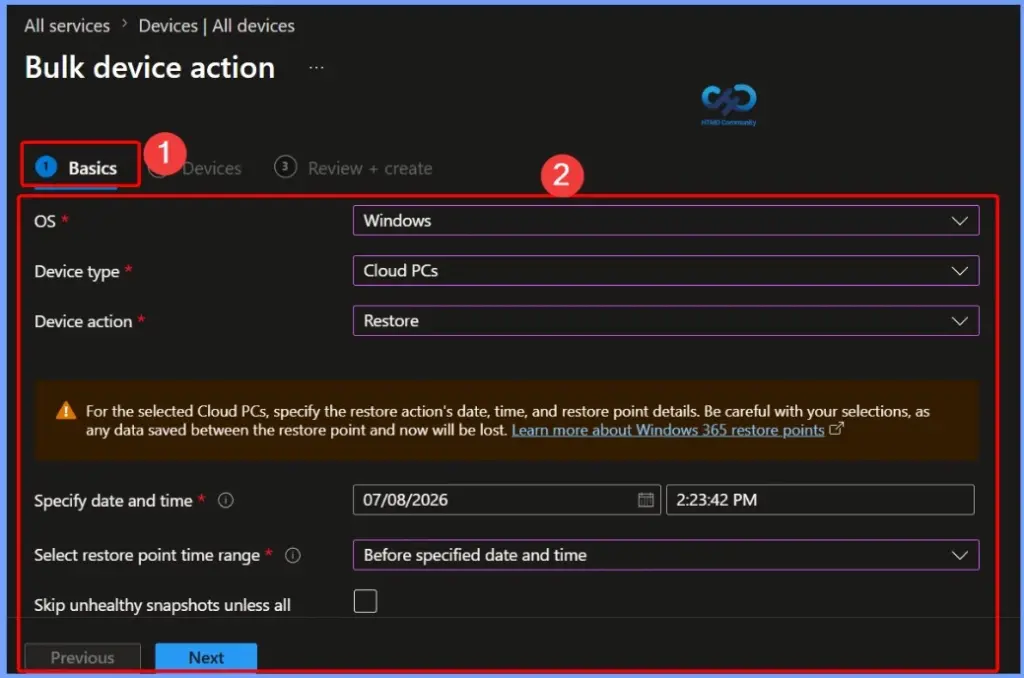
Select Devices and Create the Bulk Restore Request
On the Devices page, select the Windows 365 Cloud PCs that you want to restore, and then click Next. On the Review + create page, verify that the selected devices and restore settings are correct. Once you’ve confirmed everything, click Create to start the bulk restore operation. The selected Cloud PCs will begin restoring to the appropriate restore point based on the options you configured.
Windows 365 Cloud PCs Action Status
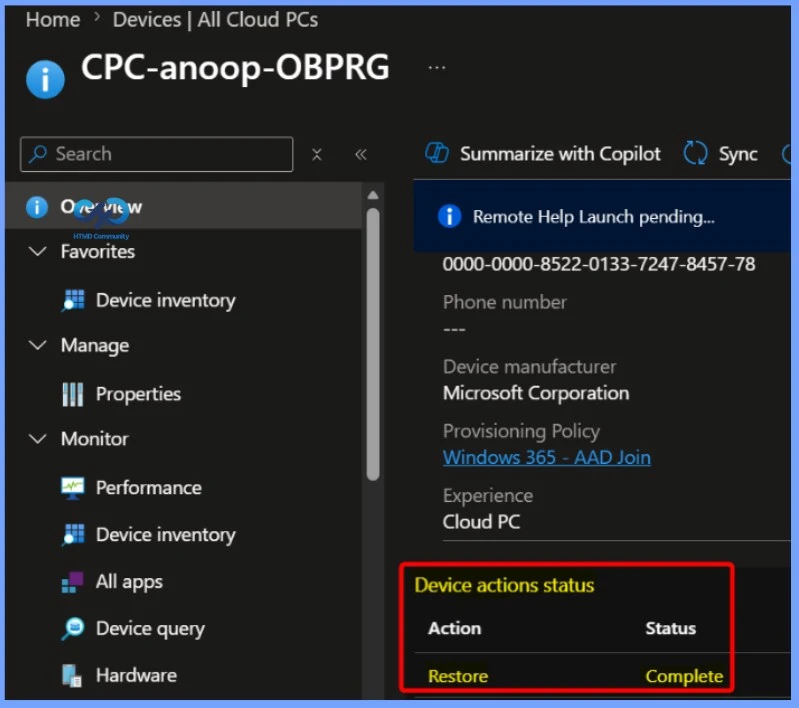
When the restoring process is completed based on Admin/User action, you will get an updated status under Device actions status for all performed actions. Once the action “Restore” is completed successfully, the status will show as complete.
End Users Experience – Restore Windows 365 Cloud PC
If you configured the settings to allow users to initiate the service, your end users can opt to restore their Cloud PC themselves. You can use the Cloud PC URL – https://windows365.microsoft.com/ to launch Windows 365 service and start working on a personalized desktop in the cloud.
The End users can access their Cloud PCs in two different ways –
- Windows365.microsoft.com
- Microsoft Remote Desktop Client (How To Deploy Remote Desktop Client Using ConfigMgr)
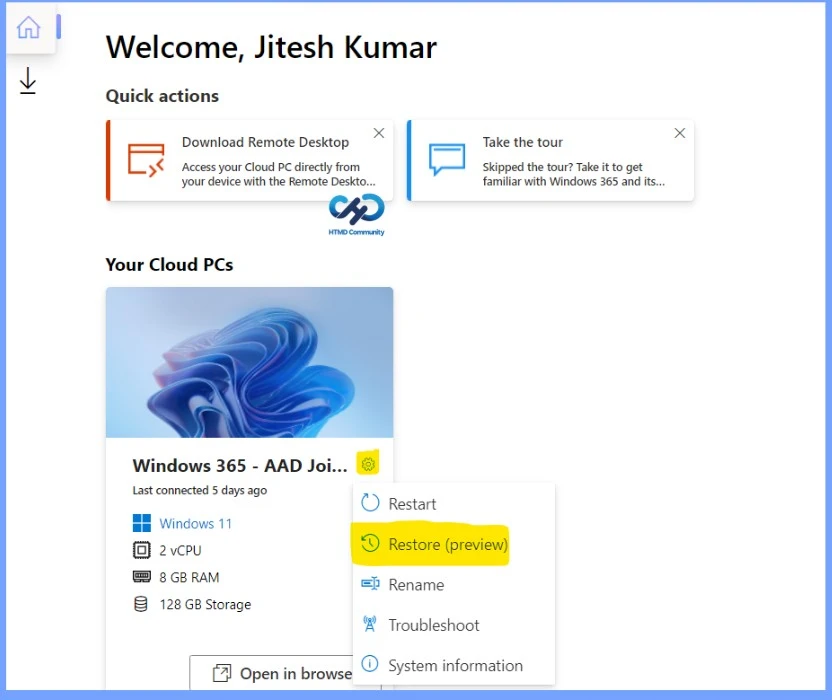
Here you can see the different Cloud PCs assigned to you in the Windows 365 web client portal. End users can easily perform maintenance on cloud PCs via the Windows 365 web portal.
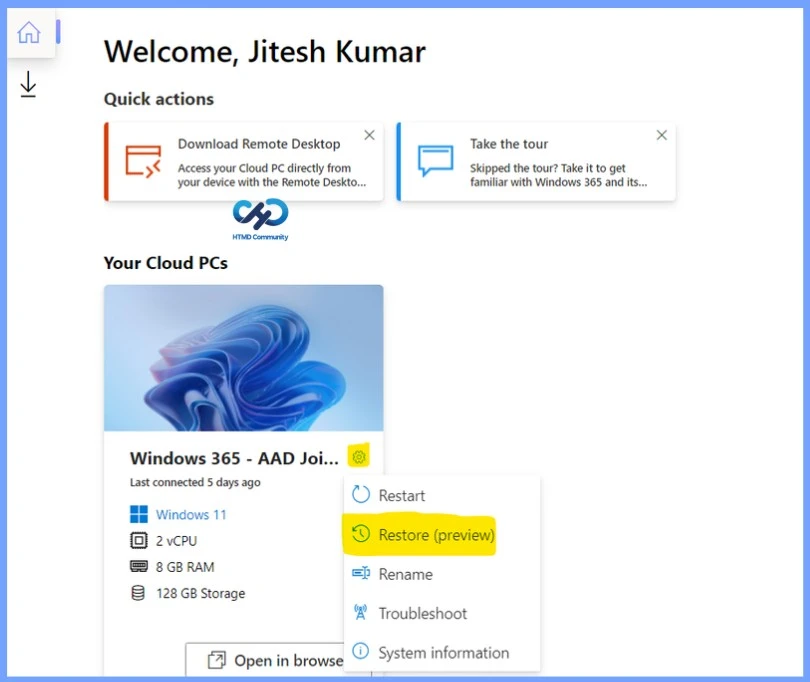
There is a settings button (gear icon) in the portal to take some of the quick actions on the Windows PC assigned to you. Select the gear icon, and select Restore (preview).
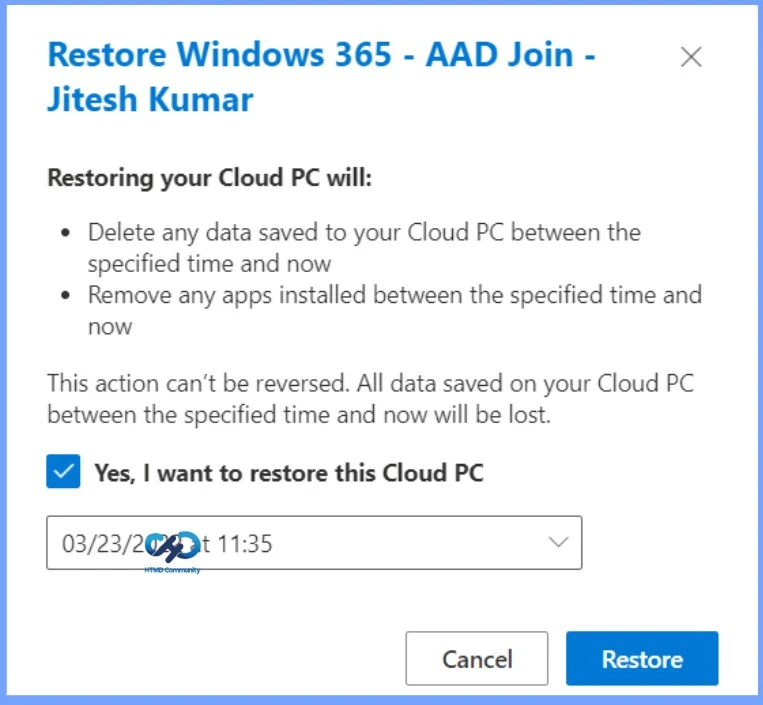
The end-user checks a box to confirm that they want to restore the Cloud PC. Select restore point. Check the box Yes, I want to restore this Cloud PC and click on the drop-down button to choose a restore point that you want to restore.
Important – Restoring your Cloud PC will:
- Delete any data saved to your Cloud PC between the specified time and now
- Remove any apps installed between the specified time and now
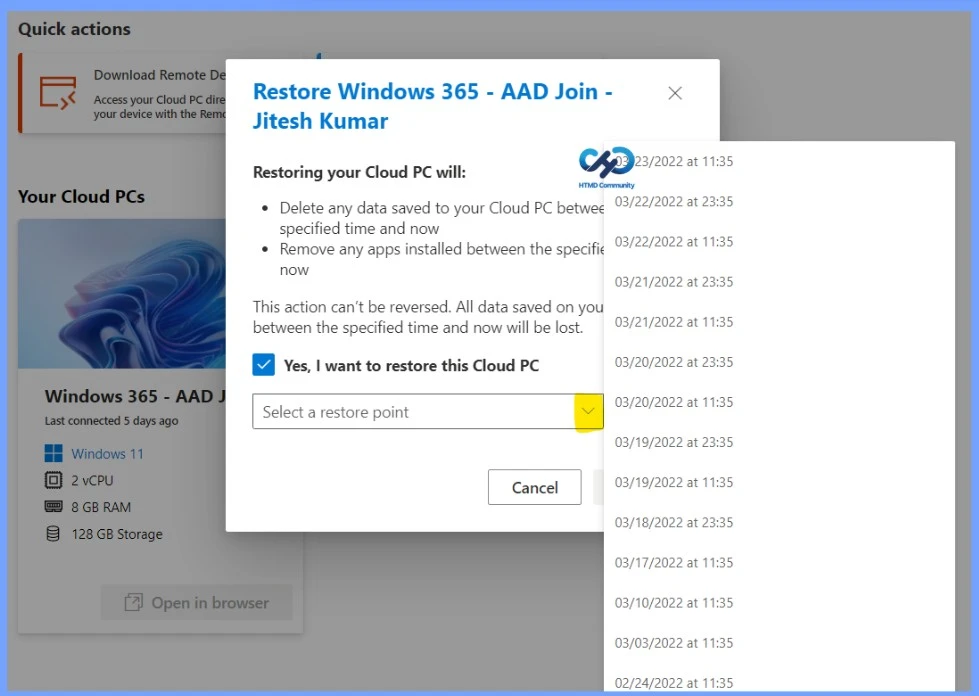
In the example below, I have selected the restore point close to the current time. Once you have confirmed your selection, click on the Restore.
Important – Choose a restore point close to the current time to minimise data loss and the risk of a rolling password conflict.
Note – The End User’s experience will be the same whether the Cloud PCs restore actions have been performed by Admins or the user. The users can only perform the activity if admins are granted permission to restore their own Cloud PCs.
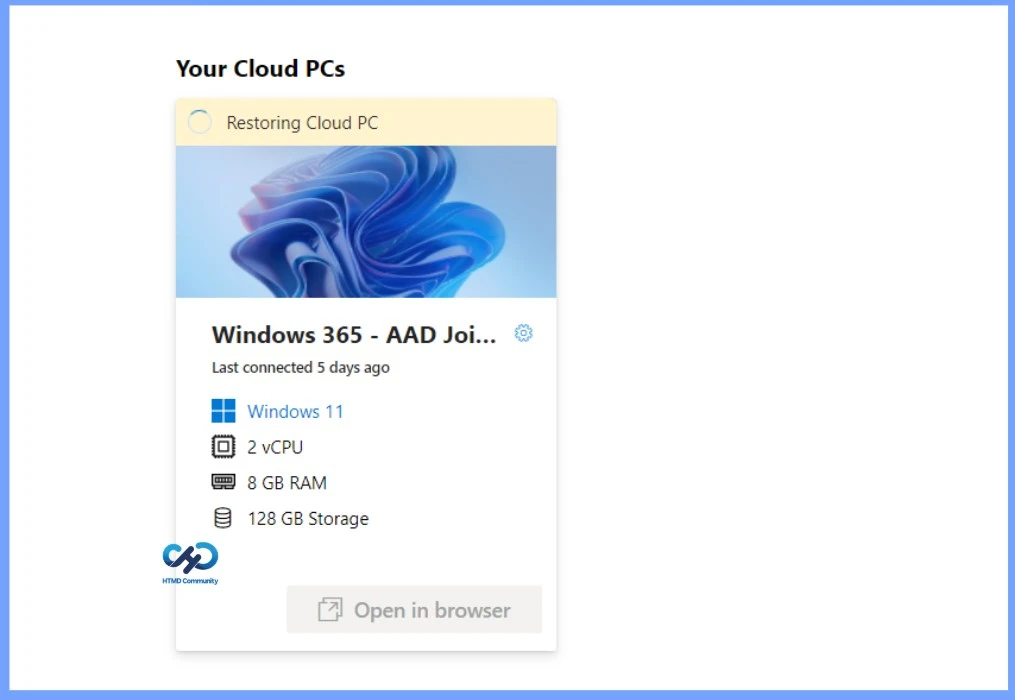
Under Your Cloud PCs, you will be able to see the action performed for the selected Cloud PC and the message “Restoring Cloud PC”.
The Restoring Cloud PC may take around 10-15 minutes, and please wait to complete the process. Once the operation is complete, “Open in browser” will be an active option.
Here you can see, Your Cloud PC was restored successfully. Let’s select Open in browser to see Windows 365 Cloud PC experience –
Note – After the restoration is complete, the user should immediately sign into their Cloud PC to verify that they can successfully connect.
If a user can’t connect or experiences unexpected behavior, try a second restoration to a different restore point that is more recent. You may need to reprovision/reset a Cloud PC on rare occasions if all restore points have obsolete rolling credentials.
Let’s check more details about Windows 365 cloud PC web client end-user experience walkthrough – Windows 365 Cloud PC Web Client End User Experience Walkthrough
Once you log in successfully, You will be landed on Cloud PC Desktop. This is how the screen will appear for you. Cloud PC is ready for productivity after restoring it successfully.

Windows 365 Business Restore Options
Let’s check what are the options to restore the Windows 365 Cloud PC business version. To restore their Cloud PC, an end-user must sign in to https://windows365.microsoft.com, select the gear icon, select Restore (preview), and follow the onscreen prompts.
The Windows 365 Cloud PC restore option is similar for both business and enterprise versions as you can in the below screenshot.
Need Further Assistance or Have Technical Questions?
Join the LinkedIn Page and Telegram group to get the latest step-by-step guides and news updates. Join our Meetup Page to participate in User group meetings. Also, join the WhatsApp Community and the Whatsapp channel to get the latest news on Microsoft Technologies. We are there on Reddit as well.
Author
Jitesh, Microsoft MVP, has over six years of working experience in the IT Industry. He writes and shares his experiences related to Microsoft device management technologies and IT Infrastructure management. His primary focus is Windows 10/11 Deployment solution with Configuration Manager, Microsoft Deployment Toolkit (MDT), and Microsoft Intune.
Hi – You mentioned – “The Point-in-time restore feature is available for Windows 365 Cloud PC, Enterprise, and Business Editions”.
How we can enable this for W365 Business? Those are not available in Windows 365 in Endpoint Manager.
Can find anywhere info regarding this.
End-user can perform this action from their login as Jitesh updated in the last section of the post now. The business version is not supported (officially) by the endpoint manager portal? Maybe restoring on time is why it’s not available for Windows 365 Cloud PC Business version. I don’t have a business version to test it.
An admin can also do a restore from the Windows 365 site.
Once logged in you can click on the Your organization’s Cloud PC’s link then a user name of someone that has a loud PC. When the User Detail side menu pops out from the right hand select Devices. Select Restore under the Cloud PC name. A window will pop up with the standard warnings then you will have to check a box and possible restore dates will pop up. Select one then proceed.